
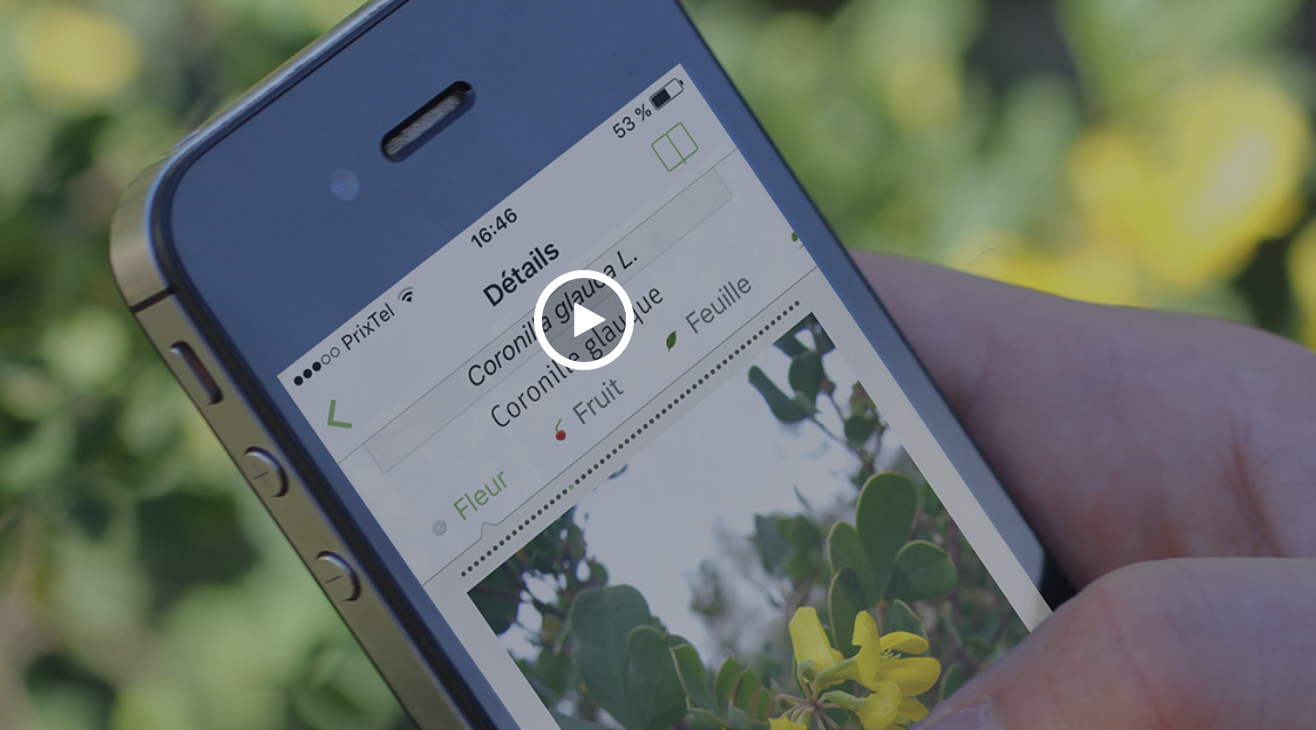
Recently, I tested a flower identification tool that looked “old-fashioned and cold”, and unexpectedly, it turned out to:
- Global downloads exceed 10 million;
- Recommended by ecologists, teachers, students, and gardening enthusiasts alike;
- It doesn’t sell ads, doesn’t implement subscriptions, has an open-source + scientific background, and is entirely supported by voluntary contributions from users.
Its name is Pl@ntNet , which is essentially an app for “identifying plant species by taking photos”, but it has been taken to the extreme and has a sense of mission, even resembling the [Wikipedia + Shazam] of the plant world.
👉 Product experience address:https://plantnet.org
While seemingly identifying flowers, it is essentially “collecting the genetic map of Earth’s plants”
At first, I thought it was just a tool to help you identify wildflowers by the roadside. But after trying it out, I found that it was far more powerful than I had imagined:
- It can not only identify flowers, but also leaves, fruits, and bark;
- It is not simply image recognition, but rather a “research-grade” comparison that combines the global plant database;
- Every upload contributes to building the “Global Plant Atlas”.
In other words: You’re not just identifying flowers; you’re participating in a global citizen science project that spans over 180 countries and involves tens of millions of users.
Echo personally tested: fast recognition speed, unexpectedly high accuracy, and a clean and comfortable user experience
I casually took three photos of plants in Chengdu (leaves in the park + flowers in the community flowerbed + fruits by the roadside). After uploading, within seconds, it provided the Latin name, Chinese name, family and genus classification, and even photo references and global distribution.
The entire app has no ads, no induced subscriptions, and a minimalist interface, resembling an honest person who “just wants to focus on academic pursuits,” which inexplicably makes people feel favorably towards it.
It has become a commonly used tool for global scientific research institutions and schools
Pl@ntNet is jointly promoted by five French scientific research institutions, including professional ecosystem data teams such as INRAE and INRIA.
Their original intention in doing this was very clear – to enable ordinary people around the world to participate in ecosystem data acquisition and science education.
Therefore, it is also widely used in natural science courses in schools, science popularization activities in parks, and even biodiversity monitoring projects.
Unlike those “flower identification tools” on the market that use filtered image recognition, Pl@ntNet is designed for scientific usability.
It can operate without relying on profit, and its model is particularly suitable for reference in the development of public welfare AI products
This app is not a startup project, has no VC investment, and does not rely on advertising for monetization. It survives solely on community support, scientific research backing, and voluntary user uploads.
And it does:
- Downloaded over 10 million times;
- Global user activity + multilingual support;
- Covers over 45,000 plant species;
- The data has also been adopted by global scientific research platforms such as GBIF;
can be said to be a model for doing public welfare, doing science, and doing open-source AI applications.
Therefore, I personally strongly recommend that friends who plan to engage in “low-cost AI + education / nature / community” seriously experience its closed-loop, data mechanism, and user growth path.
To be honest, this product deserves to be seen by more people
We always say that AI should be applied to “real-world scenarios”, and Pl@ntNet is the best example:
- Has real-world scenarios (flower recognition + education + scientific research);
- Has user stickiness (photo upload + community contribution);
- Has social value (global plant monitoring + knowledge dissemination);
- A positive cycle can be formed without monetization.
Although this model may seem “unprofitable”, it actually runs longer, has more genuine users, and has a deeper Competitive Edge.
So stop fixating on these “high-frequency AI hotspots” like writing, drawing, and Q&A.
Find a vertical scenario that is niche enough, has inelastic demand, and is meaningful. Even if it is very niche, it may still lead to a great product closed-loop.
Since you’ve read this far, if you like it, please give it a like, click “Read”, and share it with just a few clicks!
If you want to receive push notifications in a timely manner, you can also give me a star ⭐~
Thank you for reading my article. See you next time.
🍊 I am AI Blue-Haired Witch Echo
8-year Product Manager, specializing in AI × Going Global × Toolkit Practice
Test products daily and break down business logic using methodologies
Focus only on AI products that have completed the whole process and are worth learning from
📬 If you’re also looking for the next money-making AI direction, welcome to follow me
📬 Overseas / Tools / Agent Direction, welcome to add me on WeChat 👉 echoaipm
 Echo
Echo